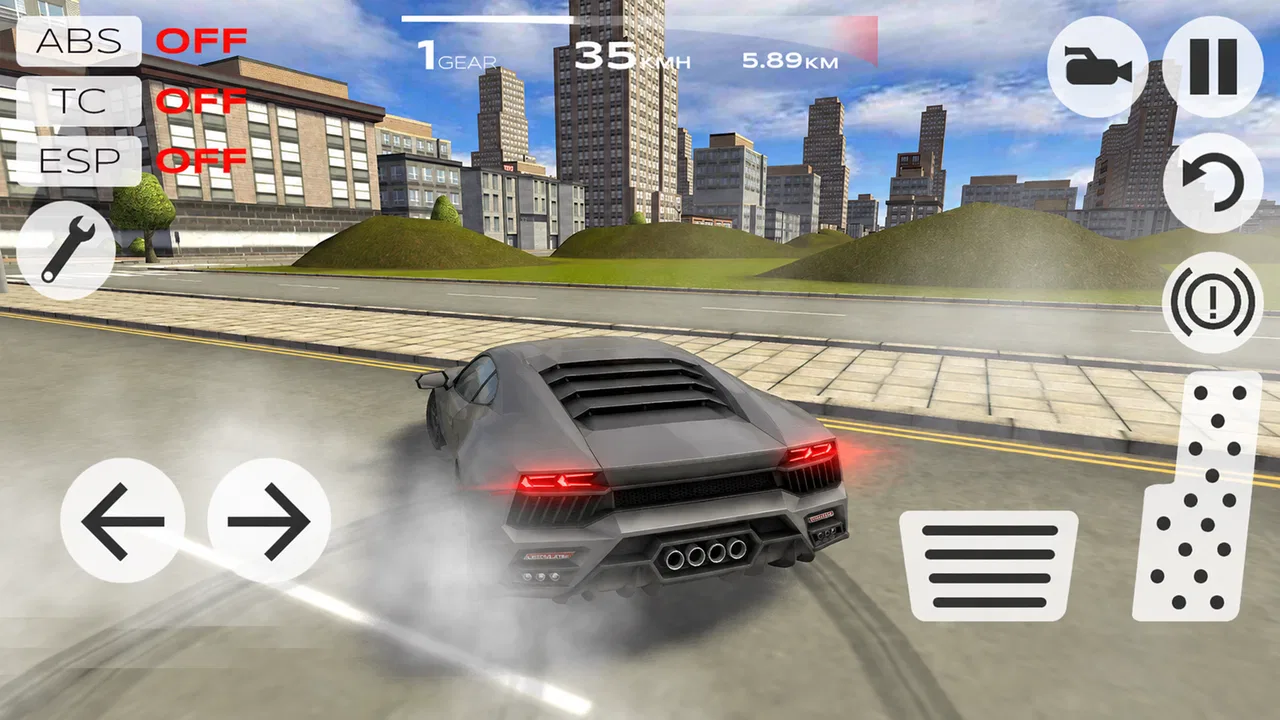
Extreme Car Driving Legends
- 4.7
- Rating
- 50.00K
- Installs
- Free
- Price

 Analysis by App-foxy
I spent time with Extreme Car Driving Legends as a compact open-world driving game, and my first impression was that it is built around immediate experimentation rather than a long tutorial or a complicated career structure. The appeal is simple: get behind the wheel, move through a free-roaming environment, and enjoy the feel of controlling a car without needing to learn a deep racing rulebook first. That makes it easy to understand, but it also means the quality of the experience depends heavily on how comfortable you are with touch controls, visual movement, and a fairly direct driving format.
Created by AxesInMotion Racing, this free racing game presents itself as a modern release of a classic open-world car-driving idea associated with 2015. It is available for Android devices running version 7.0 or later, carries an Everyone content rating, and currently appears as version 0.0.4. The audience response is encouraging, with a 4.7 average from around 851 ratings and more than 50 thousand installs. Those figures suggest that the straightforward approach is working for many players, although they should not be mistaken for a guarantee that every phone, control preference, or playing situation will feel equally comfortable.
How clearly the driving experience communicates what to do
The strongest part of the design is its readability at a basic level. You can understand the central activity quickly: this is a free-roaming driving game, not a simulation that expects you to study vehicle setup, racing regulations, or a large collection of menus before having fun. That clarity matters for players who want to open a game during a short break and begin driving without a long preparation stage.
You May Also Like

 Blood Strike: 2.5 Anniversary
Blood Strike’s Loadouts Turn Every Drop Into a Tactical Gamble
A close look at Blood Strike’s custom loadouts: how fast access to signature weapons reshapes its battle royale rhythm, rewards preparation, and narrows the gap between fights.

 Pandora - Music & Podcasts
Pandora’s Music Is Easy to Start, but Harder to Recover
Pandora’s strength is its low-effort path from a seed to a station. Its weak spot is how much confidence it asks you to place in connection, setup, and quiet recovery.

 8 Ball Pool
 Is Built on Rivalries, Rematches, and Routine
A close look at the rivalries, rematches, shared routines, and unanswered safety questions that turn a quick pool match into a persistent mobile community.

 Samsung Music
’s Quiet Strength Is Playing What You Already Own
Its reach comes less from spectacle than from dependable access to a personal library. That simplicity is both the app’s strongest retention engine and its ceiling.

 AccuWeather: Weather Radar
AccuWeather Review: A Quick, Clear Forecast for Everyday Decisions
For everyday plans, the best forecast is the one you can understand quickly. AccuWeather makes rain timing, radar, and local conditions easy to act on, with a few trade-offs.

 Hill Climb Racing
Why Hill Climb Racing Still Turns Crashes Into One More Run
A tiny car, a bumpy hill and one more upgrade: Hill Climb Racing keeps resurfacing because its simple chaos makes every near-miss feel personal.
More From Our News Desk



I also found the open-world structure useful for learning at my own pace. Instead of treating every mistake as a failure in a tightly timed race, free driving gives you room to discover how the car responds. I could use an early session to concentrate on steering, then pay more attention to speed and positioning once the controls felt familiar. This is a better starting point for a new player than being pushed immediately into a demanding competitive event.
That said, visual clarity is not the same as full accessibility. A driving game asks you to follow the road, judge distance, notice changes in direction, and keep track of several moving elements at once. On a smaller phone, those demands can become tiring even when the basic interface is understandable. I would recommend beginning with the device held steadily and the screen free from glare, because small distractions are more noticeable when your attention is split between the road and touch input.
My practical advice is to treat the first few minutes as a calibration session rather than a test of skill. Drive slowly, observe how much finger movement produces a turn, and avoid trying to explore every part of the environment immediately. This simple approach reduces the common frustration of oversteering, especially for someone who normally plays turn-based games or has little experience with mobile driving controls.
Navigation works best when you create your own routine
The open-world format gives the game a relaxed quality, but it also places more responsibility on the player. In a tightly structured racer, the next objective is usually obvious because the track itself tells you where to go. Here, the pleasure comes from choosing a direction and making your own small goals. I found that a personal routine made the experience more satisfying: start with a slow circuit, identify a few recognizable areas, and then use those landmarks to build confidence.
This is especially helpful for players who find unstructured spaces overwhelming. Rather than viewing the whole environment as one large area, divide it into short journeys. For example, use one session to practice clean turns, another to explore, and a later session to experiment with faster driving. This turns a potentially confusing open world into a sequence of manageable tasks without requiring any extra feature from the game.
The trade-off is that players looking for a strong progression path may find the freedom less motivating. If you prefer races with clear rankings, unlock schedules, or a constant stream of objectives, this experience may feel too open-ended. A conventional track racer would probably serve you better because its structure removes the need to invent your own purpose.
Motor and sensory considerations during play
Touch driving can be welcoming because it removes the need for a separate controller, but it can also create physical demands. Steering usually involves repeated finger movement and quick corrections, while acceleration and braking require you to coordinate more than one action. For players with limited fine-motor control, tremors, reduced reach, or hand fatigue, the challenge may not be the driving concept itself but the precision and repetition required by the input method.
I found that a lighter touch was more useful than pressing hard. Strong taps can make corrections feel abrupt, while gentle movements give you more time to respond. Holding the phone with both hands can improve stability, although that may not be practical for every player. Someone who needs one-handed use should test the game in a quiet setting first and decide whether the control layout can be reached comfortably without stretching.
Short sessions are another sensible adjustment. Open-world driving encourages you to keep going because there is always another road to try, but continuous steering can become tiring. I would play for a few minutes, pause, and check whether my grip or posture has changed. That is not a criticism unique to this game; it is a realistic consideration for any mobile title that depends on frequent directional input.
The visual side deserves equal attention. Fast movement, changing scenery, and the need to judge turns can be demanding for players who are sensitive to motion or visual clutter. I would avoid playing while walking, traveling over a rough surface, or dealing with bright reflections. A stable seat and controlled lighting make it easier to concentrate and may reduce discomfort caused by constantly shifting visual information.
Sound can also influence how comfortable the experience feels, even though I would not use audio as the only way to understand what is happening. Players with hearing loss should not assume that listening is necessary for basic enjoyment; the core activity is visual and interactive. Conversely, players who are sensitive to loud or repetitive game audio may prefer to lower the device volume and rely on the screen. Using headphones is optional rather than essential to the reason I would recommend this game.
Who is likely to find the controls approachable?
Extreme Car Driving Legends is a reasonable choice for someone who wants low-pressure vehicle practice and is comfortable making small touch adjustments. It can also suit younger players within the Everyone rating, provided an adult is comfortable with the child using a driving game and with the device settings around purchases. The uncomplicated premise makes it easier to explain than a complex motorsport title.
It is less suitable for a player who needs highly customizable controls, strong alternative input support, or a clearly documented accessibility menu. I would not choose it as a first recommendation for someone whose ability to use touch gestures is limited unless they can test it personally and find the movements manageable. A game with adjustable button placement, controller support, or explicit accessibility options would be a safer choice in that situation.
There is also a difference between visual simplicity and visual accessibility. The game’s concept is easy to understand, but driving still requires quick visual decisions. Players with low vision may need a larger screen, closer viewing distance, or a device with display settings that make the road and interface easier to distinguish. I would avoid promising that those adjustments solve every issue; they only make the surrounding conditions more favorable.
Playing in everyday situations
A realistic use case is a short break at home when you want something interactive but do not want to commit to a full race series. I could imagine opening it after work, spending a few minutes driving familiar routes, and stopping whenever attention starts to fade. The free-roaming format suits that kind of flexible session better than a game that penalizes you for leaving halfway through a long event.
It can also work as a casual introduction to mobile driving games. A friend who has never played a racing title could start by exploring slowly, learning the relationship between finger movement and steering, and gradually increasing speed. That learning path is more forgiving than handing a beginner a competitive racer where every mistake is immediately visible on a leaderboard.
However, the same flexibility creates a problem for shared environments. If you are playing in a noisy room, on public transport, or while other people are asking for your attention, the visual concentration needed for driving becomes harder to maintain. I would not recommend using it while walking or during any activity that already requires awareness of your surroundings. A simple game still deserves the same common-sense attention as any screen-based activity.
For families, the Everyone rating makes the game easier to consider than a title aimed at older audiences, but the free price should not be confused with a completely cost-free experience. In-app purchases range from $0.99 to $99.99 per item. I would check purchase controls before handing the device to a child, particularly if the phone or tablet is shared. That is one of the most important practical details for parents because the driving itself may be suitable while accidental spending is not.
The game’s current version is 0.0.4, so I would approach it as an experience that may still be developing. The advantage of trying an early version is that the central idea is easy to evaluate without a large investment. The disadvantage is that players expecting a mature, feature-heavy racing package may notice a more limited sense of depth. If your priority is a polished competitive ecosystem, established alternatives may offer a fuller long-term structure.
Where the experience still creates barriers
The main barrier is the gap between a simple premise and the precision of actual driving. “Easy to understand” does not mean “easy for every hand.” Steering errors can accumulate quickly, and a player with limited motor control may feel that the game is asking for constant corrections. I would have preferred more certainty about how broadly the control approach can accommodate different physical needs, so I recommend testing rather than relying on the friendly concept alone.
Another limitation is the lack of a clearly emphasized accessibility identity. I can discuss practical ways to make play more comfortable, such as using a stable grip, reducing session length, and adjusting the environment, but those are player-led workarounds. They should not be confused with built-in accessibility tools. If you require features such as remapping, larger interface controls, switch input, or detailed visual adjustments, investigate whether your device and the installed version provide what you need before committing to regular play.
Open-world driving may also be challenging for players who depend on strong navigation cues. Creating your own landmarks helps, but it does not replace a clearly guided route. Someone with spatial-processing difficulties might prefer a track-based game where the road itself provides constant direction. In contrast, players who enjoy wandering and learning an environment through repetition may see this lack of rigid guidance as a strength.
There is a similar trade-off for sensory preferences. The moving camera and changing scenery are part of the driving appeal, yet they may be uncomfortable for people sensitive to motion. Playing more slowly can reduce the intensity, but it cannot change the game’s basic visual identity. If motion sensitivity is a serious concern, a static puzzle game or a less visually active racing alternative would be a more sensible recommendation.
Finally, the game is not the best match for everyone who likes cars. Fans of detailed tuning, realistic motorsport strategy, or carefully balanced online competition may find the open-world freedom too lightweight. Its value is in accessible, spontaneous driving rather than in reproducing every part of professional racing. Knowing that distinction prevents disappointment and makes the recommendation more honest.
My inclusive verdict after driving around
My overall view is positive but specific: Extreme Car Driving Legends is a free racing game for casual open-world driving, and its clearest strength is how quickly a new player can understand the basic idea. The 4.7 average and growing install base reflect real interest, while the Everyone rating broadens its audience. I especially like it for short, self-directed sessions where the goal is to explore, practice, or simply enjoy moving through a driving environment.
Its inclusive potential comes from simplicity, not from a large collection of confirmed accessibility tools. That distinction matters. A player with comfortable touch control, adequate vision for fast-moving scenes, and a preference for relaxed exploration may find it welcoming. A player who needs extensive input customization, strong navigation assistance, or reduced visual motion should be more cautious and compare it with a game designed around those needs.
My best tip is to test the controls before deciding whether it belongs in your regular rotation. Use a stable position, begin slowly, learn one route, and stop if your hands or eyes become tired. Parents should also review purchase protections because optional items can cost from $0.99 to $99.99 each. Those small preparations address the most realistic friction points without pretending that every player will have the same experience.
For me, this is a good pick when I want a straightforward open-world car simulator rather than a serious racing championship. I would recommend it to a friend who values freedom, quick access, and casual driving. I would point that friend elsewhere if they needed detailed accessibility settings, highly structured competition, or a deeper simulation. In the right context, the game is enjoyable precisely because it does not make driving feel like homework; its remaining barriers are the touch precision, visual concentration, and open-ended navigation that come with that same simplicity.
FAQs for Extreme Car Driving Legends
01What is Extreme Car Driving Legends?
Extreme Car Driving Legends is a driving and car simulation game focused on open-world exploration, challenging driving activities, and vehicle customization. Players can drive through different environments, perform stunts, complete missions, and experiment with various cars. It is designed more for free-roaming and arcade-style driving than for a highly realistic racing championship experience.
02Can I play Extreme Car Driving Legends offline?
The game may support offline play for its main driving activities, allowing you to explore locations and use vehicles without a constant internet connection. However, certain features can depend on connectivity, including advertisements, updates, online services, or optional content. It is best to launch the game once while connected, then test the available modes in airplane mode before relying on it for offline entertainment.
03Does Extreme Car Driving Legends offer car customization?
Extreme Car Driving Legends generally includes vehicle-focused customization or selection features, depending on the version available on your device. Players can usually choose between different cars and adjust aspects of their driving experience, while some editions may include visual upgrades or performance-related options. The depth of customization is more suitable for casual players than dedicated simulation enthusiasts.
04Is Extreme Car Driving Legends suitable for children?
The game is relatively easy to understand because its main objective is driving, exploring, and completing simple challenges. Nevertheless, parents should review the age rating before installation, since the game may include traffic collisions, stunt driving, advertising, or optional in-app purchases. Younger players may also encounter frequent ads, so parental controls and purchase restrictions are recommended.
05What devices are required to run Extreme Car Driving Legends smoothly?
Performance depends on the specific Android or iOS version, the game edition, and the device’s hardware. Newer phones and tablets with sufficient free storage, updated operating systems, and a capable graphics processor should provide smoother driving and shorter loading times. On older or entry-level devices, you may notice reduced frame rates, longer loading, heating, or occasional crashes.
Pros
- Large open-world map with varied roads and driving environments.
- Responsive controls make steering and drifting easy to learn.
- Wide selection of cars with different handling characteristics.
- Frequent challenges provide goals beyond simple free driving.
- Offline play is available for enjoying the game without a connection.
Cons
- Some vehicles and upgrades require considerable grinding to unlock.
- Ads may interrupt gameplay
- especially between activities.
- Realistic handling can feel difficult for beginners at higher speeds.
- The open world may feel repetitive after extended play sessions.
- Performance can vary on older phones
- causing occasional frame drops.

Extreme Car Driving Legends
Gallery